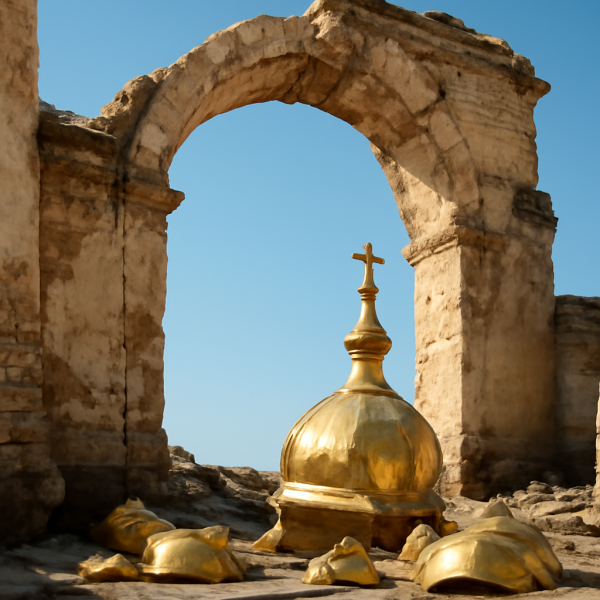
These events are not isolated; they are the echoes of a conflict that has gripped Ukraine for months, a struggle born of geopolitical tensions and territorial claims. Yet, as one witnesses the desecration of these sacred sites, the reality of sacred desecration becomes apparent, reminding of a deeper truth that transcends politics. The war is not just a battle over land, but a confrontation with the very sanctity of what is holy. "When ye therefore shall see the abomination of desolation, spoken of by Daniel the prophet, stand in the holy place, (whoso readeth, let him understand:)" (Matthew 24:15).
The Pechersk Lavra monastery, with its golden domes and ancient walls, stands as a symbol of faith enduring through centuries of turmoil. Yet, in an instant, the drone strikes have shattered the peace that once enveloped it. These assaults remind of the fragility of human constructs, even those dedicated to the divine. One desires a manageable God, yet receives a holy one. A God who does not conform to desires or political agendas, but who stands apart, calling to something greater.
Consider the scene at the foot of Mount Sinai, where the Israelites trembled at the presence of the Almighty. They were not given a God who would fit neatly into their expectations, but one who demanded reverence and awe. In times of war, when sacred sites are reduced to rubble, the reality of sacred desecration calls to remember the holiness that transcends physical structures. The God of the Bible is not confined to buildings or monuments; His presence is with His people, wherever they may be.
As one witnesses the devastation of places like Pechersk Lavra, it is essential to ask what it means to hold something sacred. The world offers no easy answers, but scripture invites wrestling with these questions. Just as the Israelites faced the challenge of faith in the wilderness, so too must one find footing in a world where the sacred is often overshadowed by the profane.
In the midst of conflict, let hearts turn back to the One who is unchanging, whose holiness calls to repentance and renewal. This is not merely a call to mourn the loss of buildings, but to seek the restoration of one’s own soul. For in the end, it is not the structures that define faith, but the God who dwells within. Come, turn, and find peace in His presence.