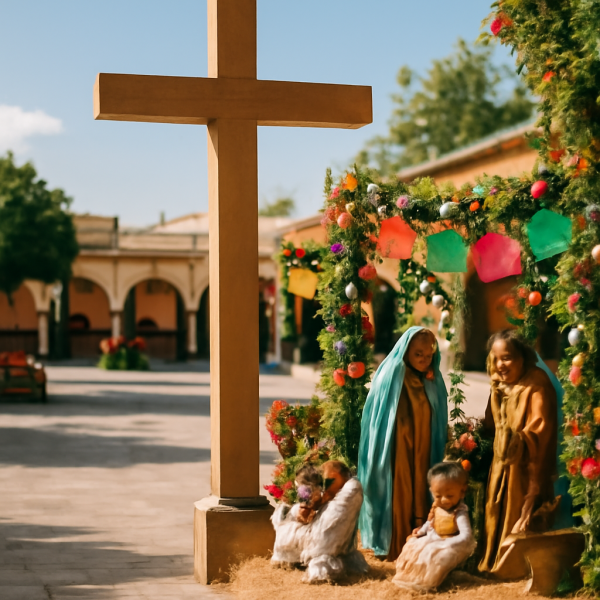
The suit, Gerritsen v. City of Los Angeles, was filed in 2025 by a city resident named Jack Gerritsen. He says he is an atheist and argues that the religious displays on public land violate the Establishment Clause of the First Amendment. He told the court they make him feel excluded.
The cross is about ten feet tall and hand-carved from wood. It was set up in 1929 at the head of Olvera Street to mark Los Angeles's 148th birthday. The Nativity is placed there each December alongside Las Posadas, the traditional Christmas procession the street has kept for generations.
In May 2026, a federal judge in downtown Los Angeles rejected Mr. Gerritsen's request for a temporary order removing the displays. The judge found that neither display violates the First Amendment. The appeals panel has now upheld that decision. The case is not over. It returns to the trial court for a final judgment.
The Olvera Street Merchants Association joined the case to defend the displays. Many of its members come from families who have worked on the street since the 1930s. The merchants told the court they hold a significant and legally protected interest in preserving the historic and cultural heritage of the place. Millions of visitors come to Olvera Street every year, and the merchants also keep Día de los Reyes and Día de los Muertos there.
What one man's discomfort cannot erase
Mr. Gerritsen deserves to be treated with courtesy, and nothing here calls for anything else. He is a neighbor and an image-bearer of God like the rest of us. But a principle sits underneath this case. If a person's sense of being left out is enough to pull a cross off public ground, then no memory is safe. The founders wrote the First Amendment to keep government from forcing a church on the people. They did not write it to scrub the record of a people who prayed. The Supreme Court has said the same in recent years about old crosses and old traditions. Those who insist that public life must be cleared of every sign of Christ want more than neutrality. They want a public square that is empty of God, and an empty square does not stay empty.
Still, the gospel does not live or die on a plaza in California. The cross in the courtyard is a piece of timber. The cross on Calvary was a Roman instrument of execution, and God turned it into the doorway of heaven. Judges may keep the wood standing or they may take it down. Neither ruling can touch what happened outside Jerusalem.
"For the preaching of the cross is to them that perish foolishness; but unto us which are saved it is the power of God." (1 Corinthians 1:18)
Notice what that verse admits. The cross has always offended somebody. In the first century it was foolishness to the Greeks and a stumbling block to the Jews, and in the twenty-first it is a grievance filed in federal court. A crucified Savior is not a comfortable thing to look at. It says plainly that man is a sinner, that his sin cost blood, and that he cannot pay the bill himself.
That is exactly why it saves. A man who feels excluded from every gathering and every good thing can be told the truth: Christ died with His arms stretched wide, and nobody is left outside that welcome except the one who turns away. He did not die for the comfortable and the certain. He died for the doubter, the scoffer, the man who sues, and the woman who walks past with her eyes down. The offense of the cross and the mercy of the cross are the same nail-pierced hand.
So Christians in Los Angeles and everywhere can be glad when a court protects an old cross and a manger scene. Be glad, and then be honest about where the power lies. It never rested in a statute, a ruling, or a lawn ornament. It rests in a risen Lord. Tell your neighbor what the cross means. Do it kindly, and do it plainly, because a courthouse can preserve the wood but only the gospel can save a soul.