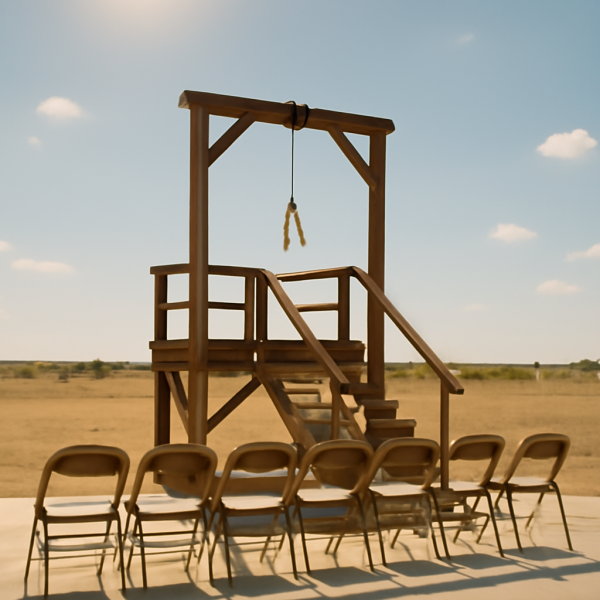
Military officials said President Trump approved the execution order on Oct. 2. A Pentagon spokesman said Defense Secretary Pete Hegseth recommended death by firing squad and that the President signed off. If the sentence is carried out, it will be the first execution by the U.S. military since 1961.
Hasan opened fire on Nov. 5, 2009, in a crowded soldier readiness center, killing 13 and wounding more than 30. A military jury convicted him in August 2013 and sentenced him to death. The case then sat for more than a decade.
A dispute arose this month over whether the public would see it. The Pentagon first said the execution would be livestreamed, which seemed to match Hegseth's earlier description of it as "public." On Oct. 15, President Trump said it "will not be streamed," reversing that plan. Hasan may still turn to the civilian federal courts, and appeals could delay the date. It is not yet clear whether he will pursue them.
What a nation owes the dead, and what God offers the guilty
Behind the schedules and the legal wrangling stand thirteen empty places at thirteen tables. Soldiers died, and one was an unborn child. Families have waited seventeen years for a day on a calendar. Whatever one thinks of the method or the cameras, no one should wave away their grief or call their wait a small thing.
Scripture is plain that civil government is not a decoration. It is an office God has placed in the world to restrain evil and protect the innocent.
"Let every soul be subject unto the higher powers. For there is no power but of God: the powers that be are ordained of God." (Romans 13:1)
The same chapter says the ruler "beareth not the sword in vain." A land that takes the murder of its soldiers lightly has forgotten what the sword is for. Those who hold that authority, from the President to the officer who carries out a lawful sentence, answer to God for how they use it. Honor is owed to the office, and a heavy duty comes with it.
But the courthouse is not the last court. A man sentenced on earth stands, like every one of us, before a Judge who cannot be rushed, bribed, or fooled. Nobody on that post will be there to hear the verdict that matters most.
Here the gospel says something the world finds hard to believe. The grace of God is not graded on a curve. The thief on the cross had nothing to offer but a dying breath and a plain request, and Jesus answered him that very day. You may feel that some crimes put a man beyond mercy. The Word of God does not say so.
"This is a faithful saying, and worthy of all acceptation, that Christ Jesus came into the world to save sinners; of whom I am chief." (1 Timothy 1:15)
Paul wrote those words about himself. He had stood by while Christians were killed. He called himself the chief of sinners, and he did not say it to be polite. He said it because he knew what he had done and what Christ had done for him.
That cuts two ways. It means no killer is too far gone to be forgiven, if he comes to Christ in truth. It also means that you and I, who have never fired a weapon, are not excused by our cleaner record. "All have sinned," the apostle says. Pride is the one sin that keeps a man from the cross, and the respectable have as much of it as the criminal.
Justice and mercy are not enemies in the Bible. They meet at Calvary, where the penalty for sin was paid in full by the One who did not deserve it. A grieving family can ask for justice and ask for nothing less. A guilty man can come to the foot of the cross and find the debt already paid. Both are true, and neither cancels the other.
There are still more than two months on the calendar. Time is a gift, and it is shorter than any of us think. Whether a man's last day is set by a court or is hidden from him altogether, it will come. The question is whether he will meet it with his sins carried by Christ or still on his own back.