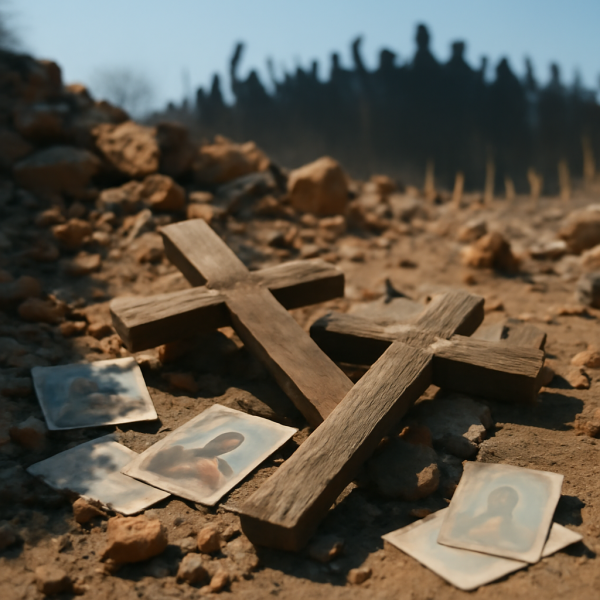
The Faridpur church had reported an extortion demand of 200,000 rupees, about $2,095, to local police the day before the attack. Officers took no action, congregation leaders say. In Murshidabad district, a Christian widow named Barnali Chatterjee says a group forced its way into her home, damaged her belongings, and pressed her to sign over her land for the construction of a Hindu temple after she refused to renounce her faith. In Bankura district, Pastor Rajib Das says activists broke up a prayer meeting, confiscated Bibles, and briefly detained worshippers, including women and children.
Christian leaders across the state have now counted at least four such incidents in the first week of July alone and are calling on authorities to investigate and to protect a religious minority that makes up a small fraction of West Bengal's population. The wave follows the Bharatiya Janata Party's victory in the state election in May, which for the first time put a Hindu-nationalist government in power in West Bengal under Prime Minister Narendra Modi's national leadership. A Christian body in the state has announced plans to protest the attacks and press for prosecutions.
A widow in Murshidabad was told to trade her land for her faith. That trade has been offered to God's people since the garden, and the answer has never once changed hands.
Every generation of believers meets some version of that offer. Give up the name of Christ, or lose the field, the house, the good opinion of the neighbors. Men in Bengal tore down crosses shouting the name of another god this month; men have torn down crosses shouting other things in other centuries. The mob changes its slogan. The demand underneath it does not. It has always been: bow, and keep what is yours.
Scripture never promised the believer a road clear of that demand. It promised the opposite, plainly, without apology or softening:
"Yea, and all that will live godly in Christ Jesus shall suffer persecution." (2 Timothy 3:12)
Notice what that verse does not say. It does not say some believers, in some countries, in some difficult centuries. It says all that will live godly. A pastor in Bengal with his Bibles seized and a Christian anywhere comfortable enough to have never lost a thing for the name of Jesus stand under the same sentence and the same promise. The difference between them is only how visible the cost has become. Christ told His own the same thing in plainer words still, and pinned a blessing to it that the world has never learned to say with a straight face: "Blessed are ye, when men shall revile you, and persecute you, and shall say all manner of evil against you falsely, for my sake" (Matthew 5:11). Blessed. Not despite the loss. In it.
That is not a word for the men doing the burning and the threatening in West Bengal, or anywhere else land gets offered in trade for a soul. Those men will answer to the God whose church they are tearing at, and He does not need this page to settle that account. It is a word for the widow who would not sign, and for the pastor whose Bibles were taken out of his hands. It is a word, too, for anyone reading this in a country where no mob has yet come to the door. The test has a way of arriving eventually, in one shape or another, and the only preparation for it is a heart already given over, before the trouble comes, to the One who was Himself reviled, and did not open His mouth.
A church can be rebuilt. A field can be signed away and mourned and forgiven. What cannot be surrendered, what the mob in Subhashgram could not touch no matter how many crosses came down that afternoon, is the thing Paul meant by godliness in Christ Jesus — a life already hidden in a hand no crowd can reach.