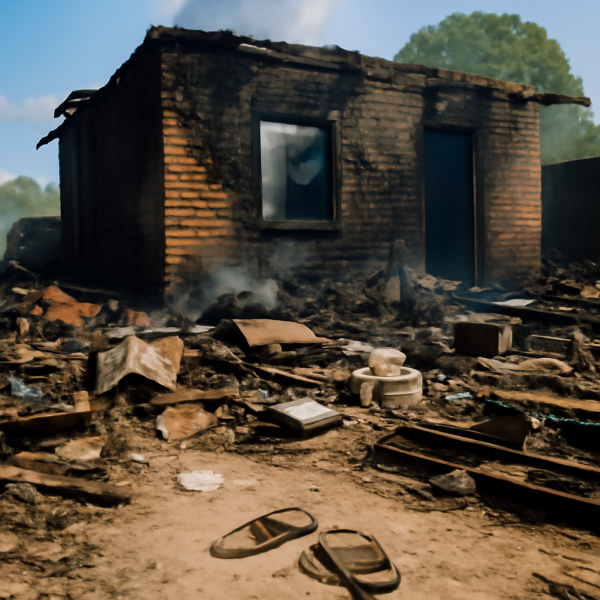
Police detained Kamran Masih, a 40-year-old pharmacist and father of three, on the night of October 8 in Gharial Kalan village, Sheikhupura District. Local Muslims accused him of sharing a video they called blasphemous in WhatsApp groups. Police said a case was registered against him under Pakistan's blasphemy law, though it remained unclear which provisions were invoked. Those allegations are unproven and are for a court to decide.
The next day a crowd gathered outside his shop and home. Some in the crowd set both buildings on fire. Police later registered a separate complaint against five people accused of ransacking the house and clinic, and arrested them. Officials deployed a large force of police to guard the Christian homes that remained. No deaths or injuries have been confirmed. Human rights monitors who looked into the case urged that the accusation be left to the courts, and condemned the arson and threats that followed.
Families did not wait to see whether the police line would hold. They have seen what happens in this country when a blasphemy charge is spoken. In 2023 a mob in Jaranwala burned dozens of Christian homes and churches over a similar accusation. So the people of Gharial Kalan packed what they could carry and left their houses behind.
What a rumor can do to a neighborhood
Think about that for a moment. One accusation, not yet tried, and a man's livelihood is ash. His neighbors, who had nothing to do with any video, are refugees in their own country. That is what a law becomes when it hands a crowd the power to be judge, jury, and executioner. Men are not safe under such a law, and neither is the truth.
The Christian in Pakistan is often poor, often a minority of one in a village of thousands. He cannot buy protection. He cannot count on the court to move fast enough. When the shouting starts, his only real shelter is the one his Lord promised.
"God is our refuge and strength, a very present help in trouble." (Psalm 46:1)
Notice the word "present." Not distant, not arriving late. A very present help. The families walking out of that village at dusk are not walking out of His sight. The Lord who saw Israel's affliction in Egypt sees a pharmacist's burned shelves in Punjab. He knows the name of every mother who gathered her children and ran.
Mark also what the Christian is told to do when he is wronged. The Scripture does not tell him to burn a house in return. It says this:
"Be not overcome of evil, but overcome evil with good." (Romans 12:21)
That is hard doctrine when your shop is in ashes. But it is the doctrine that built the Church out of blood in the first place. The mob has fire. The believer has something the mob can never touch: a Savior who was himself accused by a crowd, condemned without a fair hearing, and put to death, and who rose again on the third day. No arson can reach that.
Those of us who are safe
You and I sit in homes with locked doors and a police force that answers the telephone. That is a gift, and a gift carries a duty. The Bible says to remember them that are in bonds as bound with them. Pray for Mr. Masih, that he gets an honest hearing and a just verdict. Pray for the families who fled, for the officers standing guard, and even for the men who lit the fire, that God would open their eyes before He must judge them.
Our own government is right to speak plainly when a nation lets its religious minorities be hunted by rumor. Religious liberty is not a luxury of the West. It is the God-given right of every man to answer to his Maker with a free conscience, and no mob or statute may take it away.
My friend, whatever fire you are standing near today, hear it: the Lord is not far from the burned-out and the driven-out. He draws closest to them. Turn to Him, and He will not turn you away.