The congregation is one of the oldest in the city. It stood through the 1921 Tulsa Race Massacre, when a white mob destroyed the Greenwood district and killed untold numbers of its residents. Members rebuilt, and the church kept its doors open for more than a century.
Mayes was hired as senior pastor in October 2021. His duties included oversight of church finances, donations, collections and disbursements. Prosecutors said that between March 2022 and November 2025 he embezzled more than $504,000. The U.S. Attorney's Office said the scheme began when he opened a new bank account labeled "Administrative Expenses." He was its only authorized user, and his own home address was listed as the mailing address.
He also failed to report the money to the Internal Revenue Service. Court documents show that left him owing more than $205,000 in unpaid taxes.
Under the plea agreement, Mayes agreed to repay $504,313.88, which includes $205,765.60 owed to the IRS. He also agreed to forfeit the firearms and ammunition bought with the stolen funds. Both counts carry the possibility of prison time, and the court will set the sentence.
Whose money was it?
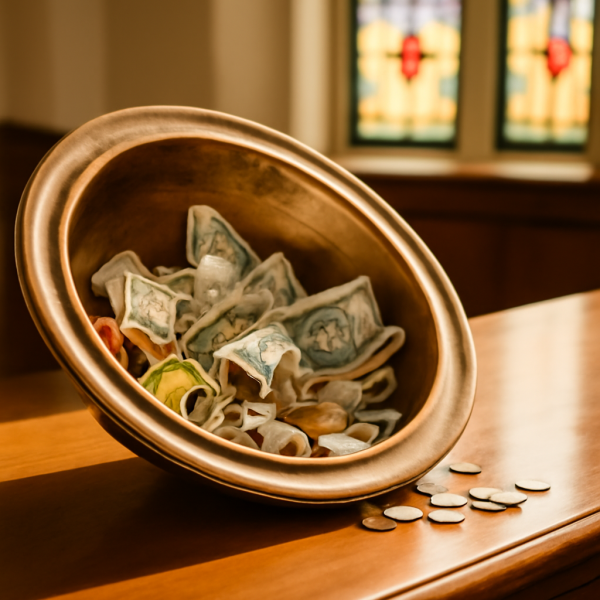
Think about where that money came from. It came from widows and working men who put a bill in the plate on Sunday morning. It came from families who had little and gave anyway, in a congregation whose forefathers knew what it was to lose everything and start again. Every dollar was given to God. A man who was trusted to guard it took it and bet it away.
My friend, I take no pleasure in this, and neither should you. A fallen shepherd is a sorrow for the whole body of Christ. But the Bible does not hide from this sort of thing. It names the root plainly.
"For the love of money is the root of all evil: which while some coveted after, they have erred from the faith, and pierced themselves through with many sorrows." (1 Timothy 6:10)
Notice the word "pierced." Money-love does not stay on the surface. It cuts the man who carries it. He hides accounts, keeps a second set of books, and lies to people who trust him. Then comes the day when the lie meets a federal courtroom. The sorrows are real, and they fall on the man, on his family and on the flock he was called to feed.
Scripture gives the charge to every overseer in the church, and it is a sober one.
"Take heed therefore unto yourselves, and to all the flock, over the which the Holy Ghost hath made you overseers, to feed the church of God, which he hath purchased with his own blood." (Acts 20:28)
Purchased with his own blood. The church does not belong to the pastor, the board or the building committee. It belongs to Christ, who paid for it at Calvary. That is why handling a church's money carries such weight. It also explains why honest accounts, open books and more than one set of eyes on the offering are not signs of distrust. They are plain wisdom, and they protect good men from bad temptations.
The gospel is not for the clean
Now, some of you are thinking, "Well, that's a preacher, and I'm no thief." Be careful. Every one of us has taken something that belonged to God: our time, our tithe, our loyalty, our worship. The man in that courtroom is not a different kind of creature than you. He is a sinner who was caught in the open. Many of us sin in the dark and are caught only by God.
The law was right to hold him to account. Repayment, forfeiture and a sentence are just, and a church has every right to expect them. Justice and mercy do not cancel each other. Yet the gospel of Jesus Christ holds out something no court can give. It holds out pardon for a man who owns his sin.
"If we confess our sins, he is faithful and just to forgive us our sins, and to cleanse us from all unrighteousness." (1 John 1:9)
Faithful and just. God does not wink at theft, and He does not turn away the one who comes to Him broken and honest. The thief on the cross had nothing to repay and no years left to repay it. He had a word, and the Lord heard it.
If you hold a trust, whether in a pulpit, a pew, an office or a home, ask who is watching and whether you could open every ledger tomorrow. Better still, ask whether you could stand before the One who sees every account. He searches the heart. And He still takes sinners.