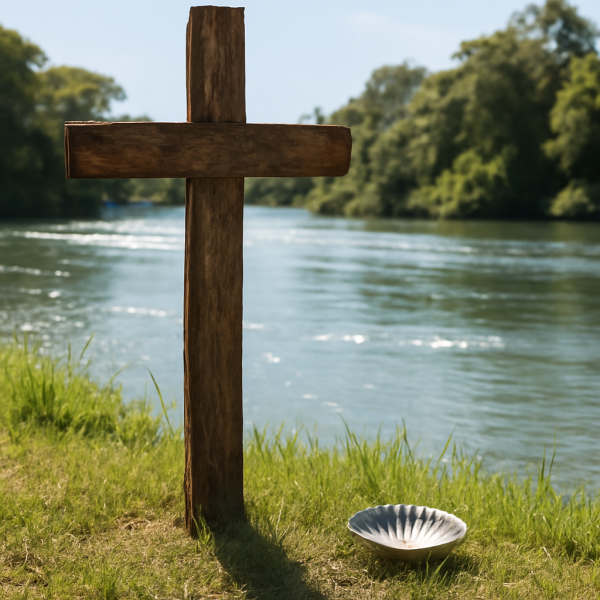
Of the 175 he baptized that final day, 160 were Christians who had been driven from their homes by the region's ongoing armed conflict. A parishioner riding with Father Crépin when the gunmen struck was seriously wounded and remains in critical condition. No group has claimed responsibility, and authorities in the Central African Republic have named no suspects, though an investigation continues.
Bishop Aurelio Gazzera of Bangassou, a missionary in the country for thirty-five years, said Father Crépin had spent himself in years of quiet peacemaking, keeping contact with rebel commanders and government officials alike, working always toward reconciliation between armed factions and displaced villagers. At times the parish in Zémio sheltered and fed more than three thousand refugees. Bishop Gazzera said it is possible the priest was killed precisely to derail the peace process now underway in the town. At the funeral, the bishop told mourners, "We must not lose heart."
A Man Who Went Toward the Trouble
Here is a man who could have kept his distance from the trouble in Zémio. He could have stayed behind mission walls and let the rebel leaders and the frightened villagers sort out their own quarrels. Instead he walked toward both sides, carrying nothing but a collar and a Bible and the name of Jesus, and he spent his last full day of life pouring water over the heads of a hundred and seventy-five souls who had lost their homes but had not lost their hope. That is not the résumé of a cautious man. That is the résumé of a shepherd. And a shepherd, my friend, does not run when the wolf shows up. He may fall. He often has, all through the history of the church, from the first martyr Stephen down to this young priest on the banks of the Mbomou. But he does not run.
The world calls that foolishness. The world says a man ought to protect himself first, negotiate from safety, keep the peace at arm's length. But the gospel has always told a harder, better story — that real peace is never made from a distance. It is made by somebody willing to stand in the gap, and sometimes that standing costs everything a man has.
"Blessed are the peacemakers: for they shall be called the children of God." (Matthew 5:9)
That verse is not sentimental. It was spoken by a Man who would Himself be killed for the peace He came to make, killed by the very people He came to reconcile to God. Father Crépin walked in that same footpath. He did not simply talk about peace from a pulpit. He drove the roads between armed camps. He sat with men who might have wanted him dead. And on his last night on this earth, he stood in a river and welcomed the frightened and the displaced into the family of God, one soul at a time.
There is a reason the Lord's own words tie the peacemaker to sonship — "they shall be called the children of God." Peace like that is not a diplomatic trick. It flows out of a heart that has already been reconciled to the Father through the blood of His Son, and only then has something real to offer a broken world.
"Greater love hath no man than this, that a man lay down his life for his friends." (John 15:13)
You may never stand between rebel factions in a river town in Africa. But you have your own Zémio — a strained marriage, a mission field at your job, a neighbor nobody else will speak to. The question the gospel puts to every one of us is not whether the danger is as great as Father Crépin's. The question is whether you will go toward the trouble carrying Christ, or keep your distance and call it prudence. The peacemakers are not the people who avoid the fight. They are the people who enter it bearing something stronger than a gun — the reconciling love of God, offered even to the men who might kill them for it.