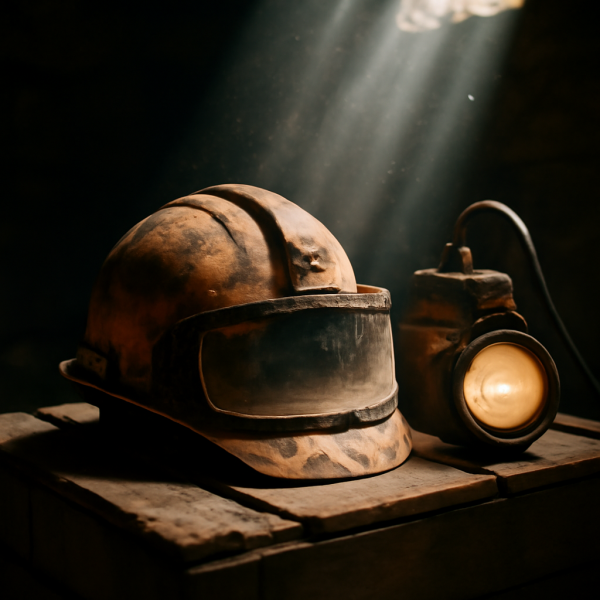
I read that number and then I read it again, because a number is a merciful thing. It lets you look at a catastrophe without looking at a man. But every one of those thirty-four had a name his mother gave him. Every one of them woke up Thursday morning like the rest of us, and put on clothes that were already dirty, and ate whatever there was, and went down. That is the part I keep turning over. They went down. Nobody makes the descent into a coal seam because it thrills them. They go because there are people at home who eat when they go and do not eat when they don't.
Scripture is not squeamish about this work. There is a chapter in Job that most folks skim past, and it is, of all things, a mining poem. Job describes men sinking shafts into the earth after silver and iron and sapphire, hanging on ropes far from where anyone walks, and he says of the miner: "He setteth an end to darkness, and searcheth out all perfection: the stones of darkness, and the shadow of death." The stones of darkness. The shadow of death. Three thousand years ago the Holy Ghost saw fit to record that men go into the black places of the earth to bring out what the rest of us use without thinking, and that the shadow of death waits down there with them. The chapter goes on to ask where wisdom is found, and answers that no mine yields it — only the fear of the Lord. But it never sneers at the miner. It sees him. It puts him in the Bible.
That is more than most of us do. I flip a light switch. I run a furnace in January. I have never once stood in my kitchen and thought about a man four thousand feet under Balochistan. The Lord thinks about him. That is the difference between His accounting and mine.
Reporting from the region notes what mine workers and labor groups there have said for years — that many of these mines lack adequate ventilation and gas monitoring and the plain safety measures that would keep methane from gathering in the dark like a held breath. I am not equipped to assign blame from this distance, and I will not pretend otherwise. But I know what Scripture says about the wages of a laborer and the cry that goes up when he is cheated of his life. God hears low sounds. He hears them from a long way off.
What steadies me is this: there was never a moment in that mine when those men were out of His sight. Not when the gas ignited. Not in whatever minutes came after. The psalmist knew the fear of being lost in the dark and answered it: "If I say, Surely the darkness shall cover me; even the night shall be light about me. Yea, the darkness hideth not from thee; but the night shineth as the day: the darkness and the light are both alike to thee." Four thousand feet of rock is not a barrier to God. It is not even a dimming. Where the rescue teams had to feel their way down with lamps and caution, the Lord was already present, and had been since the shaft was cut.
I think, too, of those rescuers. They went down after the blast, knowing what methane does, knowing the odds of finding anyone breathing. They went anyway, because bodies are not garbage and families deserve someone to bury. There is a gospel shape to that — descending into the dark ground to bring up what was lost. We know Somebody who did exactly that, and who came back up, and who is not finished bringing people out.
So pray for Sorange this week. Pray for thirty-four households in Balochistan where the money stopped and the grief started on the same afternoon. Pray for the men who will go back down Monday because they must. And the next time your lights come on, let it be a small altar. Somebody's hands are in that. God knows whose.