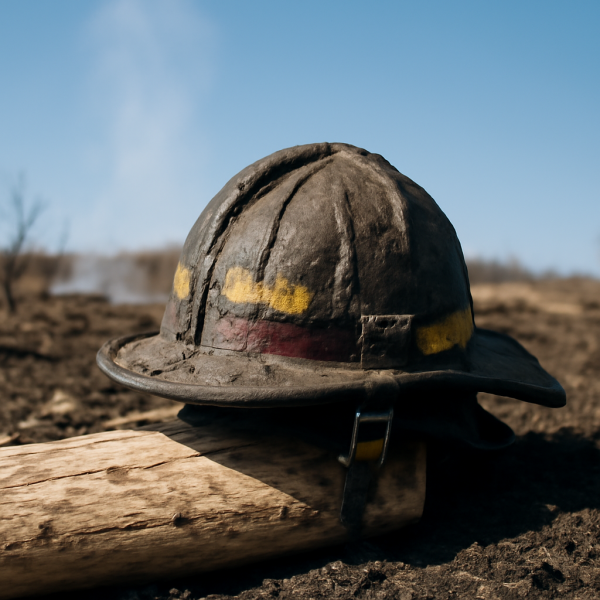
The scale of it is difficult to hold in the mind. The Gironde fire has consumed an area roughly four times the size of Paris. Some 220,000 people have been evacuated from that one region alone. On Tuesday, as heat returned and threatened the fragile hold crews had gained overnight, French authorities ordered nearly 4,000 more people out of tourist sites along the Atlantic coast. Across the border in Spain, at least 63,000 have been evacuated near Madrid. Taken together, the fires burning in France and Spain have displaced something on the order of a third of a million people. Families with an hour's notice. Car trunks packed with photographs and medication and a child's stuffed animal. Everything else left behind to whatever the wind decided.
There is a word from the prophet Isaiah that gets quoted often and, I think, misunderstood nearly as often. "When thou passest through the waters, I will be with thee; and through the rivers, they shall not overflow thee: when thou walkest through the fire, thou shalt not be burned; neither shall the flame kindle upon thee." I have heard that verse used as a kind of insurance policy, as though God had promised that the house would not burn. But look carefully at what is actually said. The waters are not removed. The rivers are not dried up. The fire is still fire, and the believer still walks through it. What God promises is not the absence of the flame. What God promises is His presence within it.
That is a harder comfort than the one we often want. It does not spare anyone the drive out of town with the sky the color of rust. It does not restore a vineyard or a stand of pines that took sixty years to grow. But it is a truer comfort, because it is the only one that survives contact with the world as it actually is. Our God does not stand at a safe distance shouting encouragement. He comes into the furnace. He walks the burned ground with us.
And I believe He does much of that walking through human hands. When I read that firefighters were injured holding a line, or that crews worked through the night so that a village might still be standing at dawn, I am not reading a merely secular story. I am reading something that Scripture taught us to recognize. "Greater love hath no man than this, that a man lay down his life for his friends." Our Lord said that of Himself, and He meant the cross. But He also planted a pattern in the world by saying it. Every time a person willingly stands between danger and a stranger, that pattern shows itself again, whether the one standing there knows the name of Christ or not. Love that costs something is always an echo of Calvary.
There was one small mercy in this week's news that I want to name, because we are quick to catalog losses and slow to count grace. Near Madrid, evacuation orders were lifted for ten towns, and about 20,000 people were told they could go home. Twenty thousand front doors unlocked again. It is not everything. It is not even most of it. But it is something, and something is where thanksgiving has to begin.
So I would ask you to pray this week for people whose names you will never learn. Pray for the exhausted crews still watching the wind. Pray for the ninety-three in hospital beds. Pray for the families sleeping in gymnasiums, doing arithmetic about what can be rebuilt. And when you pray, do not ask only that the fire be put out. Ask that they would know, in the smoke and the waiting, that they are not walking through it alone.