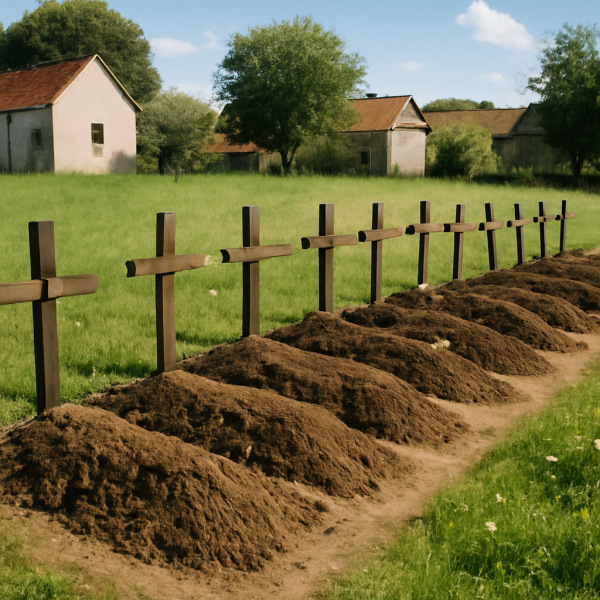
Ayilamo sits in Tombo Ward, Logo Local Government Area, roughly 112 miles northeast of the state capital, Makurdi. Residents describe the community as about 98 percent Christian, most of them Catholic. The dead include seven civilians, among them community elders, and four Mobile Police officers who were rushed to the scene once the attack began: ASP Paul Ina and Inspectors Mohammed Yusuf, Oge Ikechukwu, and Edeh Andrew.
The raid on Ayilamo fell in the middle of a week of coordinated violence across Nigeria's north and Middle Belt. Security officials counted at least 35 people killed and more than 70 abducted in attacks spanning Benue, Adamawa, Sokoto, and Kaduna states within a matter of days, prompting the Nigerian army to issue a red alert for further coordinated strikes. Benue State Governor Hyacinth Alia condemned the killings, even as a rights group, the Human Rights Writers Association of Nigeria, called on him to resign over what it describes as a pattern of failure to protect villages like Ayilamo, where similar attacks have recurred for months.
Where the Watchmen Cannot Reach
Ayilamo had watchmen. Four of them wore the uniform of the Nigerian police and spent seven hours holding a line against men who came to kill, and it ought to be said plainly: that is courage, and it is a gift, and the grief owed to those four officers stands right alongside the grief owed to the seven villagers who died beside them. But the plain truth of Ayilamo, and of a hundred villages like it scattered across Nigeria's Middle Belt, is that flesh and blood cannot always hold the line forever. The ammunition runs low. The forest swallows the men who did the killing. And in the morning there are eleven graves and no one in handcuffs.
Turn that truth over in your hand for a moment, my friend, because it is not only Nigeria's truth. Every people, every century, has buried its dead and asked whether anyone was watching. Scripture never pretends the watchmen are enough. It promises something they cannot be.
"Yea, though I walk through the valley of the shadow of death, I will fear no evil: for thou art with me; thy rod and thy staff they comfort me." (Psalm 23:4)
A shepherd wrote that verse, a man who had killed a lion and a bear with his own hands to save a lamb, and who later spent years hunted through caves by men who wanted him dead. David knew what it was to hear footsteps in the dark and wonder if morning would come. He does not say the valley is safe. He says fear is not required, because Someone is present in it who the valley cannot touch.
That is the whole of the gospel compressed into one shepherd's confession: not that God spares His people every valley, but that He walks every one of them at their side, and that the men with guns, however many, however coordinated, do not have the last word over a life hidden in Him. The apostle Paul, writing from a Roman cell, put the same conviction into different words: "them which suffer adversity" are to be remembered "as being yourselves also in the body" — not as a headline from a distant continent, but as kin.
The families burying their dead in Benue State this week are not owed a platitude. They are owed the truth that the God who counts the sparrows and numbers the hairs of a man's head has not lost track of Ayilamo because the world's attention moved to the next story by morning. He was in the valley on September 10. He will be in it when the next village is named. And He has made a place, purchased at a cost no militia can match, where the valley of the shadow of death gives way for good to a country where the watchmen never sleep and the gates never fall.