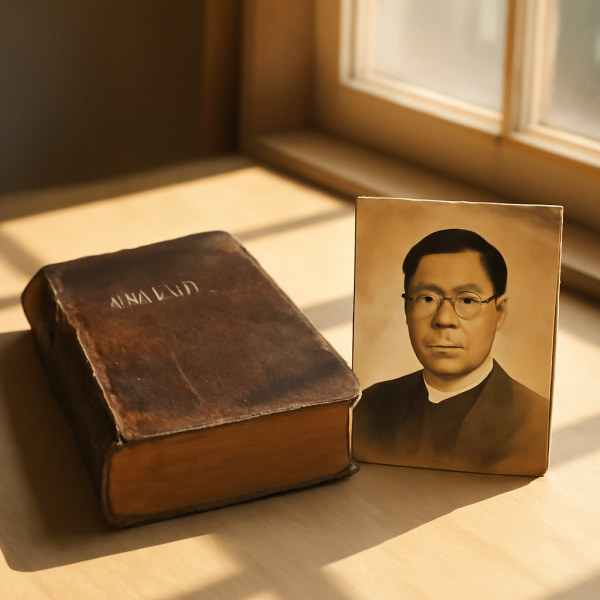
Chinese police arrested Jin at his home in Beihai, Guangxi Province, on the night of October 10, 2025, in a coordinated sweep authorities called internally the "10.9 Church Case." Officers raided homes across several provinces before dawn, cut power, broke down doors, and detained thirty other pastors and staff members alongside Jin. Eight defendants, Jin among them, were charged with fraud and illegal business operations, allegations centered on church offerings and seminary tuition. Liu said that throughout the proceedings her husband openly acknowledged preaching the gospel online, planting churches, and training disciples.
Jin founded Beijing Zion Church in 2007, and it grew to more than 1,500 members, widely regarded as the largest house church in the Chinese capital. During his nine months in custody, family members say he lost roughly 33 pounds and his hair turned mostly gray, though he remained, they said, in good spirits.
Jin's release followed a direct appeal by President Donald Trump to Chinese Communist Party General Secretary Xi Jinping during a Beijing visit in May, part of a humanitarian arrangement reached between Washington and Beijing that Chinese state media has characterized as a Fourth of July goodwill gesture. Eight Zion Church leaders remain imprisoned: Pastors Yin Huibin, Gao Yingjia, Wang Lin, Liu Zhenbin, Lin Shucheng and Wang Cong, along with Preacher Wu Qiuyu and Elder Wang Zhong. ChinaAid, Freedom House and Fortify Rights have each called on Chinese authorities to release the remaining prisoners.
What a Cell Cannot Reach
Nine months is long enough to turn a man's hair gray and strip thirty-three pounds from his frame. It is not long enough, nor is any sentence long enough, to make him unsay what he believes about Jesus Christ. That is the plain arithmetic underneath this story, and it is worth sitting with for a moment before the news cycle moves on to the next thing.
A government can shut off the power in a man's house before dawn. It can knock down his door, put him in a cell, and hand him a charge sheet dressed up as fraud when the real offense, everyone involved knows perfectly well, is that he baptized people and taught them to read the Bible. What a government cannot do, no matter how many provinces it sends its officers into, is reach the place where a man has decided Christ is worth more than his own comfort. Pastor Jin, by his wife's account, never denied what he was doing. He preached. He planted churches. He made disciples. He said so under charge.
The Bible has a word for what the church owes a man like that, and it is not admiration from a safe distance. It is remembrance, and remembrance that costs something.
"Remember them that are in bonds, as bound with them; and them which suffer adversity, as being yourselves also in the body." (Hebrews 13:3)
Eight men are still behind those doors in China tonight. Their names are not abstractions — Yin Huibin, Gao Yingjia, Wang Lin, Liu Zhenbin, Lin Shucheng, Wang Cong, Wu Qiuyu, Wang Zhong. Somewhere their wives are doing what Anna Liu did for nine months: waiting, praying, refusing to let the world forget. The command in Hebrews is not sentimental. It asks the free man to feel the chain as though it were on his own wrist. That is a hard thing to do from an American pew with air conditioning and a parking lot full of cars. It is exactly the thing scripture asks anyway.
There is also a promise underneath all of this that no interrogation room in Guangxi Province can touch. Christ did not say His church would survive persecution by luck or by diplomacy, though thank God for both in this case. He said something stronger.
"Upon this rock I will build my church; and the gates of hell shall not prevail against it." (Matthew 16:18)
Zion Church did not begin in a government registry. It began in 2007 around a man convinced the gospel was true whether Beijing approved of it or not, and it grew to fifteen hundred souls anyway. That is not a story about one pastor's endurance. It is a story about what the risen Christ does with ordinary, stubborn faith when the world tells it to be quiet. My friend, whatever cage presses against you tonight, whether it is fear, or debt, or the fading of your own resolve, take heart from a man who came out of a Chinese prison gray and thin and still preaching Jesus. The gates have not prevailed yet. They will not.