The case traces back to a Department of Homeland Security directive issued in early 2025 that reversed a longstanding rule requiring supervisor approval before agents made arrests near "sensitive locations" such as churches, schools, and hospitals. Under the new guidance, officers were told to use "common sense" in deciding when enforcement at such sites was warranted.
Quaker meetings along the Atlantic seaboard, the Sikh Temple of Sacramento, and a Cooperative Baptist Fellowship congregation in Georgia sued, arguing the policy kept worshippers away from services out of fear of arrest. The congregations presented evidence of measurably lower attendance in the months after the directive was announced.
Judge Barbara Keenan, appointed by President Barack Obama, wrote the panel's opinion. She was joined by Judge Steven Agee, appointed by President George W. Bush, in a decision that crossed the usual ideological lines. "Such a burden, even if limited in time, constitutes irreparable injury," Keenan wrote of the chilling effect on worship attendance. The panel noted the government could still attempt to justify the policy under the law's strict standard, but had failed to raise that defense at the district court and so forfeited it on appeal. The ruling is narrow — it binds only the specific congregations that sued — and it leaves room for arrests at any house of worship when officers hold a judicial warrant or face a genuine emergency.
What Keeps a Man From the House of God
Set the politics of the border to the side for a moment, my friend, and look at what this case was actually about. A body of believers stood up in federal court and said, in effect: people are afraid to come to church. That ought to stop every one of us in our tracks, whatever we think about immigration policy. Fear has kept men from the assembly of the saints since the beginning, and it never comes from God.
Scripture does not treat gathering together as optional, a nice custom for those who have the leisure for it. It calls the church to keep meeting, on purpose, especially when the days grow hard.
"Not forsaking the assembling of ourselves together, as the manner of some is; but exhorting one another: and so much the more, as ye see the day approaching." (Hebrews 10:25)
The writer of Hebrews did not say this to people living in comfort. He said it to a scattered, harassed congregation who had every earthly reason to stay home. Come anyway, he says. Encourage one another anyway. The world will always hand you a reason to skip the pew — a bill, a headache, a fear standing at the door. None of those reasons outrank the command.
A government has a real duty to secure a border and enforce its laws, and no one ought to begrudge it that. But a courtroom just reminded the nation of an older, higher fact: there is a room the state does not get to walk into uninvited, because Someone else already owns it. That is not a partisan claim. It is the claim the church has made under every kind of government since the apostles first stood before a magistrate and told him plainly they answered to a higher throne.
"We ought to obey God rather than men." (Acts 5:29)
That verse has never been a call to lawlessness. Peter said it standing calmly before the very council that could have had him killed, and he did not resist arrest — he simply would not stop preaching. The distinction matters. A Christian honors the badge and the bench. But when the question becomes whether a man may walk through the sanctuary door to worship his Maker without looking over his shoulder, the church has always known which authority gets the final word.
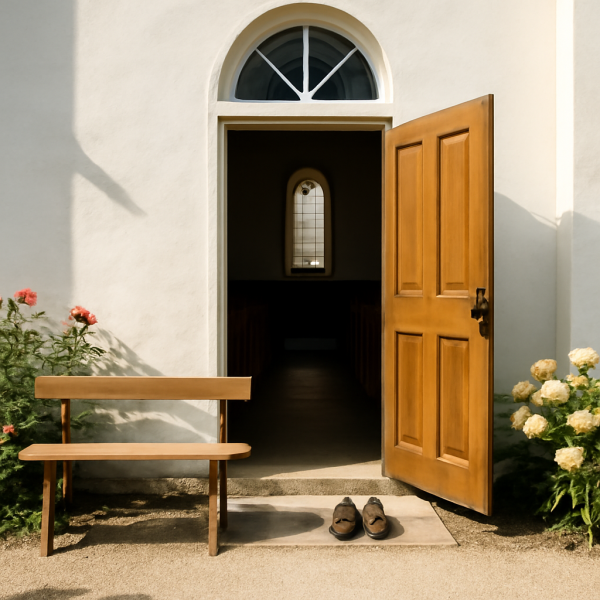
If fear of any kind — a fear of arrest, a fear of what the neighbors will say, a fear of what it will cost you — is keeping you from the pew this Sunday, take it to the One who never once turned away a soul who came looking for Him. The doors of that house were never locked. Come on in.