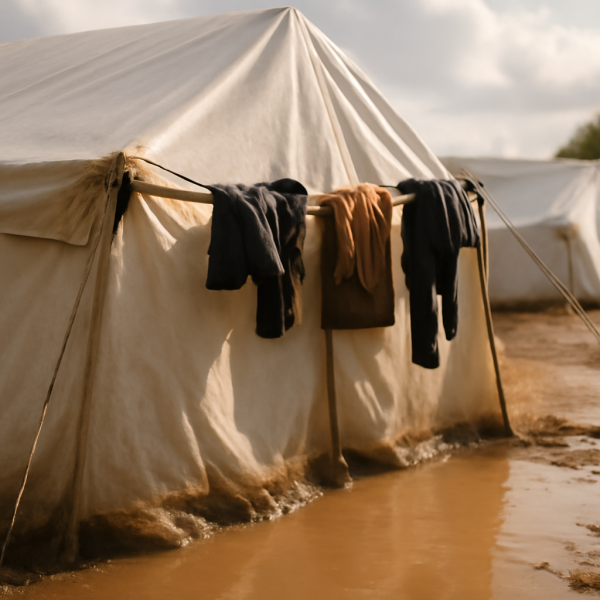
One detail has stayed with me all week, and I cannot shake it loose. The flooding reached all thirty-three of the Rohingya refugee camps at Cox's Bazar. Not most of them. All of them.
Nearly a million people live in those camps. They have lived there for almost nine years now — which is to say that children have been born there, learned to walk there, and are old enough to carry water there, having never once seen the country their parents fled. The shelters are tarpaulin and bamboo, set into hillsides that were cleared of trees to make room for them. Everyone who works in that place has known for nine years what a hard rain would do to a deforested slope crowded with makeshift houses. Last month it did it. Three landslides tore through Camps 7, 11 and 15 in the dark hours of one morning and killed eight people, five of them children. Two days later a retaining wall gave way onto a religious school in Ukhiya and killed eight more — seven students and their teacher. The refugee coordination platform counts fifteen refugees dead in this emergency, twenty-two injured, thirteen thousand displaced from shelters that were already, by any honest measure, a form of displacement.
I want to be careful here. It is easy for a preacher to reach for a disaster in a far country the way a man reaches for a prop, and I do not want to do that to these families. So let me simply say what Scripture says, and let it stand.
The God of the Bible has a particular tenderness that our politics does not know what to do with. Moses put it plainly to a people who were about to have a country of their own for the first time: "He doth execute the judgment of the fatherless and widow, and loveth the stranger, in giving him food and raiment. Love ye therefore the stranger: for ye were strangers in the land of Egypt." Notice the order of it. First, what God does — He loveth the stranger, and that love is not sentiment, it is bread and a coat. Then, what we do, and the reason we do it: not because we are generous, but because we remember. Because we were strangers once. Because the ground we stand on was given, not earned.
That is the part I find hardest, and I suspect I am not alone. Most of us have arranged our lives so that we do not have to remember. We have a roof that does not come off in wind. We have a hill behind the house that has never once come down. And the settledness we enjoy quietly persuades us that settledness is the normal condition of human beings and that the Rohingya are an exception. They are not an exception. They are the ordinary condition of most people in most centuries, and we are the exception, and we did not arrange it.
Our Lord took this even further than Moses did. He said the stranger is not merely someone God loves. He said the stranger is where He Himself will be found: "For I was an hungred, and ye gave me meat: I was thirsty, and ye gave me drink: I was a stranger, and ye took me in." He did not say the stranger reminds you of Me. He said I was. There is no way to be tender toward Christ while being indifferent to a family on a hillside in Ukhiya, because He has told us plainly where He is standing.
Aid has come — an emergency allocation from Europe at the end of last month, meant to reach a hundred and twenty-five thousand people. It is real and it will help, and it is also small against a need that the response plan itself acknowledges it cannot meet. I mention it not to make anyone feel a certain way but because I think we should look straight at it. The world's attention is a finite thing and it has largely moved on from Cox's Bazar, the way the rain has.
Yours does not have to. You cannot rebuild a retaining wall in Ukhiya from where you sit. But you can refuse to let these people become a number, and you can pray for them by name to the God who does know their names, and you can let the memory of your own unearned shelter make you gentler toward every stranger who is actually within your reach this week. That is not a small thing. Whoever is nearest to you is the stranger you have been given.