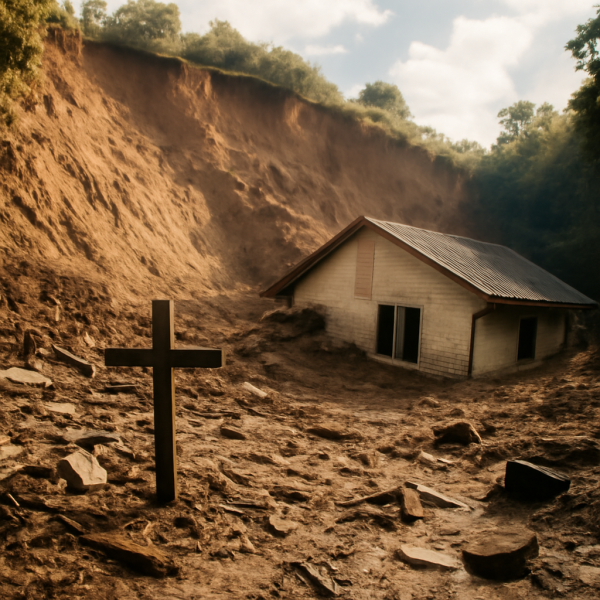
I keep returning to that phrase in my mind: the ground let go. We do not think about the ground. That is rather the point of it. A man builds a house on a hillside because the hillside has always been there, and his father's house stood on it, and his grandfather's before that. The mountain is the one thing in his life that does not move. And then one night, in the dark, in the noise of rain, it moves.
There is a psalm that seems to have been written by someone who had seen exactly this. "God is our refuge and strength, a very present help in trouble. Therefore will not we fear, though the earth be removed, and though the mountains be carried into the midst of the sea; Though the waters thereof roar and be troubled, though the mountains shake with the swelling thereof. Selah."
I want to be careful here, because there is a cheap way to read that psalm and an honest way. The cheap way makes it a promise that nothing bad will happen to the faithful. It is not that. The psalmist is not saying the mountains will hold. He is saying the opposite. He is granting the worst case — the earth removed, the mountains carried into the sea — and then locating his refuge somewhere other than in the mountains. He has already conceded the geology. What he will not concede is the fear.
That is a harder and better word, and it is the only kind of word worth bringing to a family sleeping tonight on a gymnasium floor in Idukki. It does not tell them their house will be there in the morning. Some of those houses are already gone. It tells them that the God they pray to was never resident in the foundation, and so was not lost when the foundation went.
Isaiah says it with a tenderness that undoes me every time I read it: "For the mountains shall depart, and the hills be removed; but my kindness shall not depart from thee, neither shall the covenant of my peace be removed, saith the LORD that hath mercy on thee." Notice how the same verb does double duty. The hills are removed. The covenant is not removed. Whatever else the Lord permits to slide down the slope, His kindness stays put. Of all the things I would have chosen to be permanent, I confess I would have picked the hills. He picked His mercy instead. In the end that is the better arrangement, though it takes a long night of rain to teach it.
I think also of the ordinary people who spent those days doing the work — the ones who searched for hours in the mud at Vagamon until they found the man they were looking for, and could bring him home to be buried rather than leave him lost. That is not a small thing. That is love refusing to accept a partial answer. Two hundred and nine camps did not open themselves. Somebody unlocked the doors, carried in the mats, made the rice, counted the children.
So pray for Kerala this week. Pray for the eight who are still missing as I write, and for the families waiting on word about them, which is its own particular agony. Pray for the ones digging. And when you pray, do not ask God to make the world solid, because He has not promised that and we would only lean on it wrong. Ask instead for what He has actually pledged: that when everything else is carried into the sea, His kindness will not depart. Selah — which is to say, stop here awhile, and think about it.