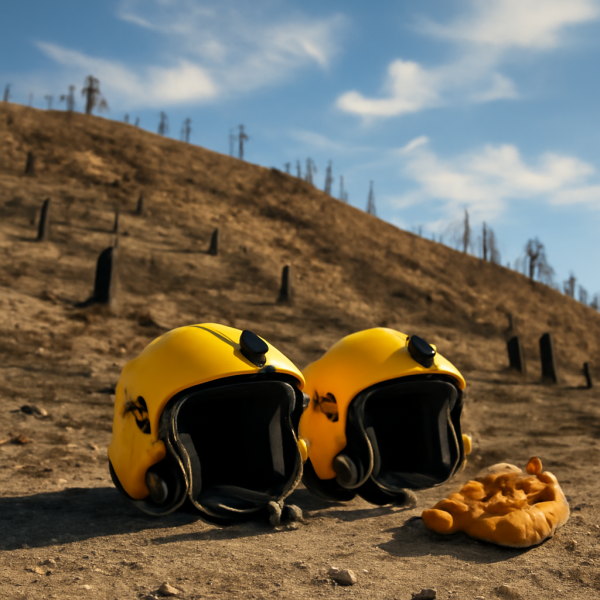
Two men were killed: a Danish pilot and a Greek fire service coordinator. The crew of the other helicopter, a British pilot and a second Greek coordinator, released their water load, brought the machine down, and were pulled from the wreckage alive, injured. Greece's prime minister said the loss of the two men "fills us all with grief."
I keep returning to the makeup of those two crews. A Danish pilot, flying an aircraft leased from an Australian operator, over Greek hills, with a Greek officer beside him in the cockpit to translate the radio and read the ground. A British pilot in the other seat, in the other machine. None of these men were defending their own villages. Fire does not check a passport, and neither, it seems, did they. They had come a long way from home to hover in the smoke above someone else's country and pour water on someone else's hillside, and two of them did not come back down.
There is a verse I have preached at more funerals than I can count, and I have never once felt that it had been used up. Our Lord said it on the last night of His freedom, to men who did not yet understand what He was telling them: "Greater love hath no man than this, that a man lay down his life for his friends." He was speaking of Himself. He was headed for a garden and a courtyard and a hill, and He knew it. But He did not say it in a way that walled it off from us. He set it down as a measure — the highest measure there is — and every time a human being spends himself for the safety of another, that measure is laid against the act, and the act is found to be a true one.
I do not know the state of those men's souls, and I will not pretend to. That is God's business and not mine. But I know what they were doing when the smoke closed around them. They were between the fire and the people. Below them, more than a thousand had been moved out of the path of the blaze, and better than two hundred and fifty of them were taken off the beaches by boat, because the roads were no longer a way out and the sea was the last door left open. Somebody is alive today, sitting in a folding chair in a relief hall, complaining about the coffee, because those helicopters kept coming.
What moves me nearly as much is what happened the next morning. At first light on Monday, five water-dropping planes and five more helicopters took off. The men in those cockpits had heard the news. They knew exactly what the smoke could do to them, and they flew into it anyway, on the morning after. That is not recklessness. That is duty carried while grieving, which is one of the hardest weights a person ever picks up.
The fire itself, investigators said, appears to have started from sparks off a faulty power line. A frayed thing, a small ordinary failure, and then a hillside gone and two graves to dig. That is how it usually goes in this world. We are always more fragile than we feel, and we never get to choose the hour.
So I take shelter where Scripture tells me to take it: "God is our refuge and strength, a very present help in trouble." Not a refuge from trouble — the psalm is honest, and does not promise that — but a help in it, present, near, closer than the smoke.
Pray tonight for two families, one in Denmark and one in Greece, who are receiving people at the door and do not know what to say to them. Pray for the injured men, and for the crews still flying. And ask the Lord, as I am asking Him, for a life that is spent rather than merely stored — poured out on someone else's hillside, for someone else's sake, while there is still daylight to fly in.