Most of these men, the bishops say, were not kingpins of anything. They were poor men looking for work, recruited by traffickers to carry parcels across the border from Yemen, and they did not know what was inside the parcels they carried. They signed papers, the bishops write, that they could not read. They were not able to follow the proceedings that decided whether they would live. Whatever a court has ruled, that much is a description of men without power — the sort of men who have always been most likely to end up on the wrong side of a locked door.
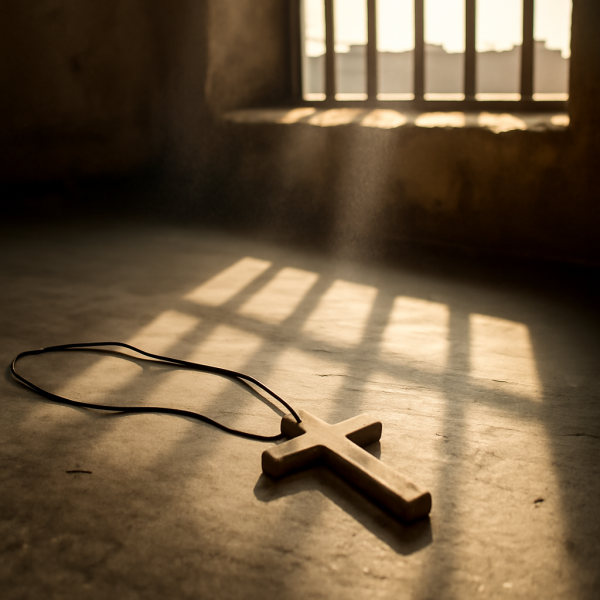
One detail in the letter stopped me and has not let go. The bishops report that crosses these men wore around their necks were taken from them, that they were assaulted, and that open expression of Christian belief was discouraged or forbidden. Some, the letter states, were tortured. I have no way to weigh those claims myself, and I will not pretend otherwise; they are the bishops' account, made publicly and in writing to the man who could act on them. But I keep thinking about that small cheap cross on a cord, the kind a mother in Ethiopia might tie around her son's neck before he goes north to find work. Somebody's hand undid the knot.
Scripture does not let the church treat a prison as a place outside its concern. "Remember them that are in bonds, as bound with them; and them which suffer adversity, as being yourselves also in the body." That is Hebrews 13:3, and it is not a suggestion to feel sorry from a distance. As bound with them. The writer asks us to remember these men the way we would remember our own bodies — the way you cannot forget a broken arm. We are told to carry them in the imagination as though the cell were ours, because in the reckoning of Christ, the body of the church has no foreign members. A man in Khamis Mushait who prays the same Lord's Prayer I pray on Sunday morning is not a stranger to me. He is family with an address I will never visit.
I confess how easily I fail at this. My remembering has a short half-life. I read a headline, my chest tightens for a moment, and then supper is ready. But the Psalmist reminds me that God's memory is not like mine: "For he hath looked down from the height of his sanctuary; from heaven did the LORD behold the earth; To hear the groaning of the prisoner; to loose those that are appointed to death." Those last words are almost unbearable in their precision. Those that are appointed to death. Not a metaphor. A calendar with a name on it. And the God of heaven bends his ear to that particular groaning, from that particular cell, in a prison whose name most of us learned only this week.
So what do we do, we who have no diplomatic standing and no seat at any table? We do the thing the bishops did, which is the oldest work of the church: we refuse to let people disappear quietly. We name them. We pray for them by number when we do not have their names — fifty-eight men, and by other accounts many more in that same prison. We pray for wisdom for those who negotiate, and for mercy in the heart of the man who holds the pen. We pray for the mothers in Ethiopia waiting on a phone call.
And then, because prayer that stops at the horizon usually stops at the heart too, we look nearer. Most of us know somebody bound in some way — behind actual bars, or behind an illness, or behind a shame that keeps them from church. Remembering them costs a visit, a letter, a name spoken aloud. It is a small obedience. But it is the same obedience, and it is practice for the greater one.
Their crosses were taken. The cross was not. It never is.