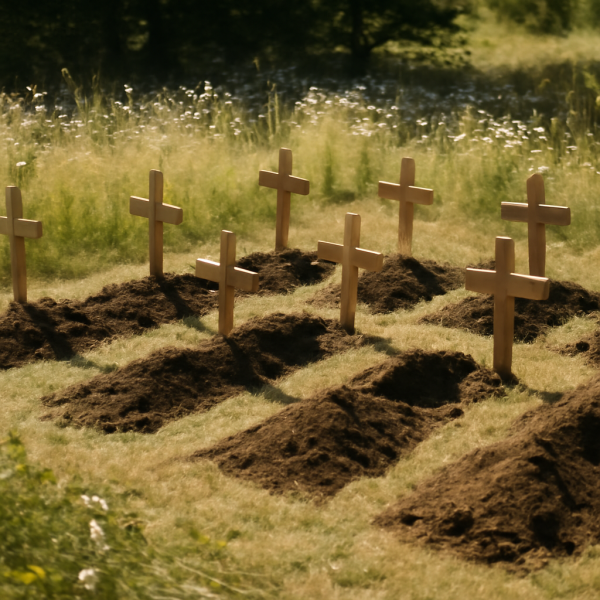
Dachomo, a regional leader of the Church of Christ in Nations (COCIN), was not home when the gunmen arrived. Witnesses said the attackers asked, "Where is the father of this house?" and told the family, "Today, you will learn a hard lesson," before firing indiscriminately into the compound. Days later, the same militia sent Dachomo a written letter promising to kill him and members of his congregation just as they had killed his relatives.
The attack was not Dachomo's first encounter with grief on this scale. By the close of 2025 he had already presided over more than seventy mass burials for Christians slain in Plateau and neighboring states. Earlier this year, President Trump shared one of the pastor's own photographs on social media, an image of Dachomo leading the funeral of roughly twenty believers killed in an earlier raid, drawing wide attention to the violence gripping Nigeria's Middle Belt.
The U.S. State Department condemned the July 12 killings, telling reporters it had reviewed accounts of the assault and calling it part of "a shocking level of violence against Christians" carried out across the region, much of it attributed to armed Fulani ethnic militias operating with little consequence against farming communities. American officials and Christian relief organizations have pressed the Nigerian government to act.
A Man Marked for Death
Nine graves dug in a single afternoon do more than end nine lives. They leave a question standing over the survivor, and that question has a name this week: Ezekiel Dachomo. The men who murdered his family did not hide their purpose. They came asking for him by description — "the father of this house" — and when they could not find him, they left a warning in writing that they mean to finish the job. That is the plain, hard fact a man of God in Plateau State wakes up to every morning now.
I want you to sit with that a moment, my friend, because most of us will never carry a threat like that in our pocket. We complain about smaller things. We call it persecution when someone rolls their eyes at a Bible verse posted online. Somewhere in Nigeria tonight, a preacher is deciding whether to keep preaching knowing the next funeral he leads might be his own. And he is still preaching.
The Lord Jesus did not promise His people a soft road. He told them plainly what was coming, and He told them just as plainly what mattered more than the coming of it.
"And fear not them which kill the body, but are not able to kill the soul: but rather fear him which is able to destroy both soul and body in hell." (Matthew 10:28)
That is not a verse for greeting cards. That is a verse for men with death threats in their mailbox. It does not promise the body will be spared — Dachomo's family is proof enough that it will not always be — but it draws a line around the one thing no militia, no letter, no bullet can touch: the soul that has been hidden in Christ. The men who wrote that threatening letter have power over flesh and blood. They have no power at all over the eternity of a believer who has trusted the Lord.
Scripture does not treat the death of the faithful as a small or forgotten thing, either. The Psalmist wrote:
"Precious in the sight of the LORD is the death of his saints." (Psalm 116:15)
Precious. Not tragic accident, not statistic, not one more line in a report — precious in the sight of God. The infant killed in that compound, the grandparents, the cousins who never harmed a soul, are held by a God who counts every one of them dear. That does not erase the grief. It answers it.
What do we do with a story like this from three thousand miles away? We can start by refusing to grow numb to it. We can say the man's name — Ezekiel Dachomo — and remember that he is a real shepherd tending a real flock under a real threat, not a distant statistic. And we can let his courage rebuke our comfort. A man who keeps burying the dead and keeps preaching the living Christ over their graves is teaching the rest of us something about what faith costs, and what it is worth.