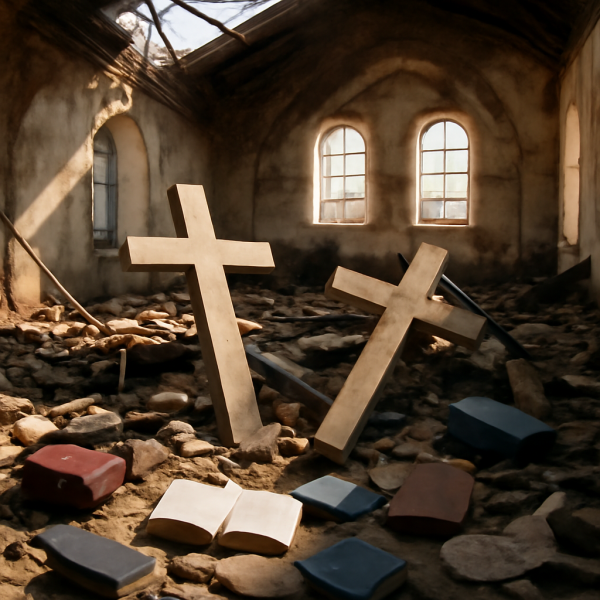
At Grace Church in the Faridpur locality of Katwa, in East Burdwan district, a mob armed with sticks beat the pastor and members of the congregation during Sunday worship, then made off with cash, mobile phones, trophies, and identity papers. Residents told reporters the attackers identified themselves with the Hindu Jagran Manch, a group tied to the Rashtriya Swayamsevak Sangh, the ideological parent organization of the BJP. Church officials said a demand for 200,000 rupees, more than $2,000, had been made the day before the assault, and that police had not acted on an earlier complaint about threats against the congregation.
That same day, a crowd forced its way into a half-built church at Buri Bot Tala in South 24-Parganas district, threatening worshippers and tearing down three rooftop crosses. In Murshidabad district, a mob surrounded the home of a Christian widow and demanded she renounce her faith and surrender her land for a Hindu temple. In Bankura district, a group seized Bibles and briefly held worshippers at a Protestant prayer meeting, and in Suvas Gram, on the edge of Kolkata, attackers broke windows, desecrated the altar, and destroyed instruments at a Presbyterian congregation of the Mizoram Synod.
Herod Mullick, a founding member of the Bengal Christian Council, said believers are "deeply concerned over what appear to be systematic attacks on our churches, institutions, and community members." Christian leaders across the state have called on police to investigate the pattern behind the assaults and to provide protection for congregations that have worshipped in the same buildings for generations.
A widow told to hand over her land or lose her faith. A pastor struck down in the middle of Sunday prayer. An offering, meant for the Lord's work, carried off in a mob's pocket. That is not a story from some ancient martyrology. That is July of this year, in the fields and river towns of Bengal, happening to people whose only offense was gathering to sing and pray.
An Old Story, Told Again
My friend, the man who follows Christ has never been promised an easy road, and the church at Faridpur found that out the hard way this month. Scripture does not soften this. It does not tell us persecution is a strange accident that befalls the unlucky few. It tells us plainly what to expect.
"Yea, and all that will live godly in Christ Jesus shall suffer persecution." (2 Timothy 3:12)
Paul wrote those words to a young pastor named Timothy, and he did not write them to frighten him. He wrote them so Timothy would not be surprised when the blow came, so he would stand steady instead of wondering if God had somehow lost His grip on the world. The widow in Murshidabad, the pastor in Katwa, the small congregation in Suvas Gram picking glass out of a broken window — none of them are outside the reach of that promise, and none of them are outside the reach of the God who gave it.
The Kingdom Does Not Belong to the Mob
The Lord Jesus said something that ought to steady every believer who reads of a church ransacked half a world away.
"Blessed are they which are persecuted for righteousness' sake: for theirs is the kingdom of heaven." (Matthew 5:10)
A mob can break an altar. It cannot break the kingdom. It can seize a Bible off a table, but it cannot tear the word out of a believer's heart. Sticks and threats can empty a man's pockets; they cannot empty his soul of the hope that put him in that pew on a Sunday morning in the first place.
What happened in West Bengal ought to move every Christian to pray for brothers and sisters who now worship under threat, and to remember that the freedom to gather without fear is no small mercy. It is not owed to any nation as a right of nature — it is a gift, and where it is stripped away, the church has never once stopped being the church. It simply keeps meeting, keeps singing, and keeps trusting the God who has never lost a single one of His own to a mob, a government, or a grave.