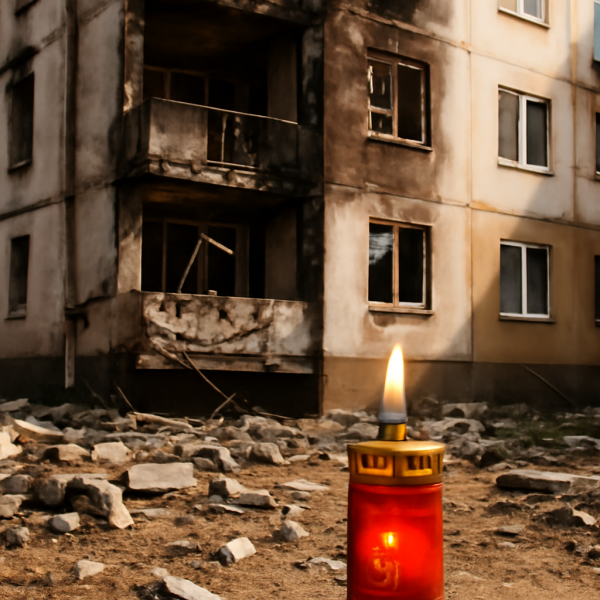
Three of Ukraine's most prominent church leaders responded within days of the bombardment. Major Archbishop Sviatoslav Shevchuk, head of the Ukrainian Greek Catholic Church, said the assault on the capital was unusual "not only in scale, but also in the deliberate shelling of residential areas, using cluster munitions which violate fundamental norms of international humanitarian law." Metropolitan Epiphany Dumenko, primate of the Orthodox Church of Ukraine, called Russia "this evil occupying empire" that "time and time again... terrorises and kills peaceful Ukrainians, taking lives and crippling innocents." Metropolitan Onufriy Berezovsky, who leads the Moscow-linked Orthodox Church in Ukraine, added his own condemnation as well, a rare point of agreement among Ukraine's divided church bodies.
City officials in Kyiv confirmed damage across dozens of locations in the capital, including apartment towers, in the days that followed. The strikes came only weeks after a mid-June drone attack set fire to the Dormition Cathedral at the Kyiv-Pechersk Lavra, a monastic complex nearly a thousand years old and a UNESCO World Heritage site. Ukraine answered with retaliatory strikes of its own on occupied Crimea and an oil refinery in Omsk, more than 1,500 miles inside Russian territory, even as diplomats in Ankara debated how to end a war now grinding through its fifth year.
When the Walls Come Down
Cluster munitions and cathedral fires make the newspapers because a camera can find them. What no camera can capture is the older war going on underneath the visible one — the argument, as old as Babel, between what a man builds with his own two hands and how long it actually stands.
An empire that flattens apartment towers in the night believes, for the moment, that it is strong. A monastery near a thousand years old believes, across the centuries, that stone and gold leaf will outlast the men who threaten it. Neither belief survives contact with a drone strike. Scripture never told a man to put his trust in the missile or in the monastery. It told him to put his trust in the Lord.
"God is our refuge and strength, a very present help in trouble." (Psalm 46:1)
That verse was not written for a quiet afternoon. It was written by a man who had watched mountains carried into the midst of the sea, waters roaring, kingdoms moved and nations in an uproar. The woman in Kyiv who buried a mother or a son this week did not lose that loved one to an abstraction called geopolitics. She lost that loved one to a man who gave an order. Scripture does not flinch from calling that wickedness, and it does not ask the griever to pretend otherwise.
But scripture will not let grief have the last word either. The LORD is nigh unto them that are of a broken heart, and saveth such as be of a contrite spirit — that is the promise of Psalm 34:18, and it was true in the ruins of Jerusalem long before it was true in the ruins of Kyiv. Vengeance belongs to the Lord, not to generals or diplomats, and He alone has the right to repay it in His own time (Romans 12:19). What is left for the rest of us is plainer work: grieve honestly, pray for the men firing the missiles as earnestly as for the families burying the dead, and put no more confidence in a cathedral or a capital city than the Book ever asked anyone to put in one.
Jesus Christ was crucified by an empire that also believed itself invincible, under a governor who thought he held the power of life and death in his own hand. Three days later that empire's stone was rolled away and found empty. Rome buried plenty of men. It could not keep that one buried. That is the only refuge sturdy enough to stand under a family in the rubble of an apartment block — and it stands open to the aggressor as readily as to the victim, for both are equally guilty before a holy God, and both are equally invited to repent and live.