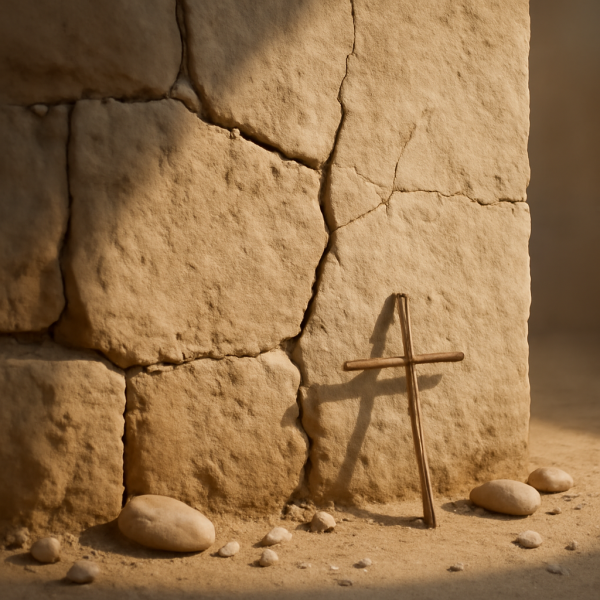
I want to sit with that for a moment before we move on too quickly. There is a particular kind of news we almost never stop to consider, and it is the news of the disaster that did not happen. We are trained by our screens to notice ruin. We scroll past mercy. But somewhere near Suez there are men and women who sat straight up in bed at three in the morning with their hearts hammering, who reached for a child in the dark, who stood in a doorway counting seconds — and then the shaking stopped, and the walls held, and the morning came, and nobody died. That is not nothing. That is a gift, and gifts have Givers.
I think of the psalmist, who seems to have known exactly what that midnight feels like. "God is our refuge and strength, a very present help in trouble. Therefore will not we fear, though the earth be removed, and though the mountains be carried into the midst of the sea." Notice what he does not say. He does not say the earth will hold still. He does not promise that the mountains will stay where God put them. He grants the worst case and then plants his flag in it anyway. The confidence of Scripture is never a confidence that nothing will move. It is a confidence about who is holding us while it moves.
That is worth saying plainly, because a great deal of what passes for faith in our day is really just a bet that the ground will stay level. We build our lives on the assumption of stability — the job, the health, the mortgage, the country, the body that has always cooperated. And it works, more or less, until three in the morning. Then some quiet fault line we never knew was beneath us slips, and everything we thought was foundation turns out to have been furniture.
The writer of Hebrews puts his finger on this with a surgeon's precision: "And this word, Yet once more, signifieth the removing of those things that are shaken, as of things that are made, that those things which cannot be shaken may remain." Read that again slowly. The shaking is not the enemy of the work of God. The shaking is part of the work of God. It is how He sorts the made things from the eternal things. It is how He shows us, with a mercy that does not feel merciful at the time, what we have actually been standing on.
I have watched this happen in living rooms and hospital corridors more times than I can count. A diagnosis comes. A marriage cracks. A phone rings at an hour phones should not ring. And in the aftermath, people discover two things at once — how little their scaffolding was worth, and how much more there was underneath it than they knew. I have seen people who thought their faith was thin find, in the rubble, that it went down further than they had ever tested. That is the kingdom which cannot be moved, and you often do not learn you possess it until something shakes.
So let us do two things today. Let us give thanks — genuine, specific, unhurried thanks — for a night near Suez when the earth moved and no one was buried. Mercy that goes unnamed tends to go unnoticed, and a Christian ought to be the sort of person who names it. And let us also do the quiet work of checking our own foundations while the ground is still. Where are you standing? What are you counting on? Which of your certainties are made things?
The earth will move again. It always does. But there is a refuge that is not a building, and He does not shift when the fault lines do. He is a very present help in trouble — present, note, not distant, not summoned, not late. Already there in the doorway with you at three in the morning, before you were even awake enough to be afraid.