And in those twenty-six minutes, homes that families had paid on for thirty years were opened to the sky. Businesses were flattened. Trees that had shaded four generations of children were snapped like kindling. Tens of thousands lost power. Water systems were disrupted. The governor declared a state of emergency. Two hospital systems in Appleton and Neenah treated roughly seventy people between them, nearly all with minor injuries.
And no one died.
I want to be careful how I say that, because I know what it sounds like from the outside. It sounds like a tidy ending, and there is nothing tidy about standing in your driveway looking at the place where your bedroom used to be. But I am a pastor, and I have buried people after storms like this one, and I will not pretend that a town of that size taking a direct hit at midday on a Monday and losing no one is an ordinary thing. I do not know how to account for it except to give thanks. Some mercies we only recognize by what did not happen.
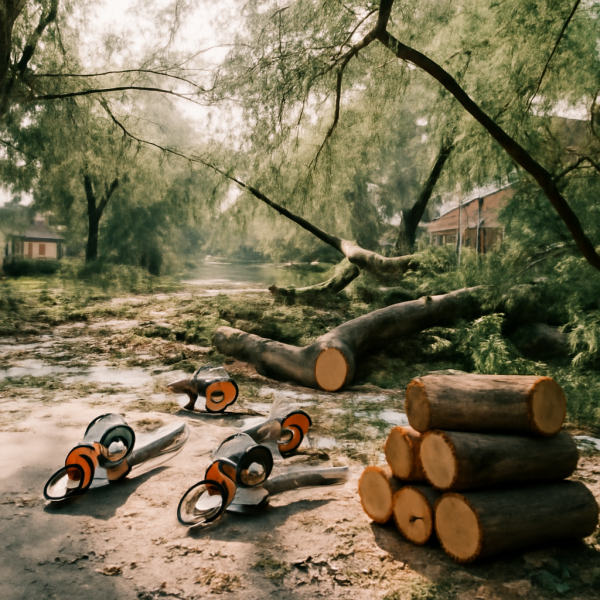
What has happened since is, to my mind, the more remarkable story. Reporters who went into the hardest-hit neighborhoods in the days afterward described the same thing over and over: the sound of chainsaws on every street. Not on some streets. Every street. Neighbors cutting their way through fallen oaks to reopen roads. People tarping a stranger's roof before the next rain could finish what the wind had started. Relief teams on the ground within a day. A volunteer center set up at a former college campus in Menasha, opening its doors at eight in the morning and running until five, sending ordinary people out with work gloves and water jugs to houses they had never seen belonging to families they had never met.
That is not a human interest story. That is theology with a chainsaw in its hands. Paul wrote to the Galatians, "Bear ye one another's burdens, and so fulfil the law of Christ." He does not say admire one another's burdens, or grieve over them from a comfortable distance, or post about them. He says bear them. Get underneath them. Take the weight onto your own shoulders until it costs you something. And the astonishing claim in that verse is that when you do, you are not merely being decent — you are fulfilling the law of Christ. The whole moral weight of the gospel comes down to earth in a man dragging a limb off his neighbor's porch.
The psalmist knew something about wind and water. "God is our refuge and strength, a very present help in trouble." I notice what he does not say. He does not say God is our insurance policy against trouble. He does not say the faithful get a wider berth from the storm. He says God is present help in it — in the basement with the flashlight, in the emergency room, in the driveway three days later when the adrenaline wears off and the enormity of it finally lands. A refuge is not a place where nothing happens. A refuge is a place you are held while it does.
Here is my concern, and I offer it as a pastor rather than a critic. The chainsaws will thin out. They always do. The cameras have mostly gone already. But the insurance calls, the contractor delays, the child who cannot sleep through wind, the widow who cannot lift what needs lifting — those go on for months. The church has never been very good at the sprint and never needed to be. We were built for the long, unglamorous middle, when helping is no longer dramatic and is simply required.
So pray for the Fox Valley. And then look down your own street. Somebody on it is standing in rubble of one kind or another, and the law of Christ is not fulfilled at a distance.