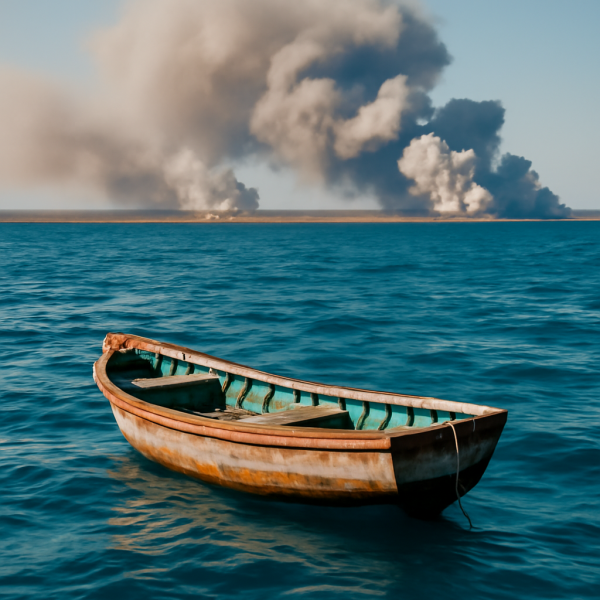
I am a pastor, not a firefighter, and I have never had to run from a wall of flame. But I could not read that account without an ancient promise rising up in me, spoken by the prophet Isaiah to a frightened people who felt the ground giving way beneath them: "When thou passest through the waters, I will be with thee; and through the rivers, they shall not overflow thee: when thou walkest through the fire, thou shalt not be burned; neither shall the flame kindle upon thee" (Isaiah 43:2).
Notice what the Lord does not promise. He does not say there will be no water and no fire. He does not offer us a tidy life with the flames kept always at a comfortable distance and the flood forever on some other, distant shore. He says through. Through the waters. Through the fire. The road of faith does not detour around the hard places; it goes straight into them and out the far side, and the whole weight of the promise rests on the small, immense word set in the middle of it: I will be with thee.
I keep thinking, too, about the rescuers. They did not stand on a safe hill and shout instructions, waiting for the terrified crowd to save themselves. They turned their boats toward the smoke. That is the shape of every true rescue, and I believe it is the very shape of the gospel. Our God is not a spectator to our danger. In Christ He came toward the fire, not away from itΓÇödown into our smoke and heat and fear, to lift us out when we had run clean out of road and out of strength.
The Psalmist knew this from the inside. He had felt the earth itself turn unreliable, the mountains carried into the midst of the sea, and still he could sing, "God is our refuge and strength, a very present help in trouble" (Psalm 46:1). A very present helpΓÇönot a distant one, not a help that arrives only after the danger has passed and the damage is done, but a help that is near, at hand, in the trouble itself. He does not always spare us the trouble. He gives us Himself in the middle of it.
Perhaps you are reading this with fire at your own back today. It may not be a wildfire on a beach. It may be a diagnosis, a grief that will not lift, a marriage grown cold, a fear you have told no one. You have looked for a road out and found the roads closed. Hear me, friend: the closing of the roads is not the closing of the mercy of God. When the only way left is the open sea, that is often exactly where the Lord has been waiting all alongΓÇöout past the edge of what you could arrange for yourself, ready to carry you.
Those four hundred did not save themselves. They were carried. And so, in the end, are we all. Whatever waters you are passing through this week, whatever flame seems ready to kindle upon you, do not face it as though you were alone on the sand. Lift your eyes to the water. The Rescuer is already turning His boat toward your shore.